Tag: History

  • Women in Tech

    Why we need to talk about women in tech

    It started with a rant on how Bluesky handles its data. (On Bluesky I might add.)

    This post started the back history of why I hate how Bluesky handles its data, but that is just empty text that serves no purpose. But what did spawn from that was me throwing thoughts into the ether on women in tech moving on to how the lack of teaching the history of tech to the younger generations is crippling them.

    I meet up once a month with other women and women presenting folks for a women in tech event. We get together, drink beer and cider, eat pretzels and beer cheese, while we talk about our work, our interests, and our projects. I’ve met a lot of cool people that way which is helping me build a network here in lower N. Michigan.

    (A woman no one knew showed up one meeting and asked if her boyfriend could come talk to us about our ideas on his new app. The boyfriend showed up anyway and spent the entire evening taking over the conversation. We were all stunned. Here is our place to not be with men and yet he couldn’t stop mansplaining the project. The woman never came back and the coordinator of our meet-up apologized profusely for letting that happen. Look, men, women and non-binary folks need their own space; stop trying to take over!)

    A young whippersnapper joined us back in the summer of 2025 and she was soliciting us to come speak to her peers at the local community college on women in STEM. I threw my hat in the ring, we had a video chat, and I told her my story of how I took a class called Introduction to the Internet back in 1994 or ’95 and it was all command line. Archie, Veronica, Pine, FTP, and IRC were our tools of choice. These words mean very little now, especially to people like the young whippersnapper.

    I’m in an interesting position since I started out in tech all those years ago but swapped to the humanities in the early ’00s when the company I worked for was going through massive layoffs. I wasn’t on the chopping block but I took that as a sign to get the hell out of dodge. I applied to a few colleges, got accepted, and in the winter of 2003, I was sitting in a classroom for the first time in nearly a decade.

    Since those early days of my academic career, while I continued to pursue a humanities degrees (double major of English Lit and Art History; masters in Humanities, masters in Library Science and Archives), tech never left my world. I was building, exploring, or fixing things. I was the go to person for friends and family. I took to the internet like a duck to water and found jobs that catered to both halves of my brain. I’m a hybrid.

    When finding a library job after I graduated in 2010 was nearly impossible (I eventually got hired for a library systems admin in 2011), I thought about going back into tech again. The money was certainly better, and surely how non-males were treated was better, right?

    I’ll let you chew on that for a bit.

    (The answer is “no” and in some ways, it’s a lot worse. If you are a non-male working in tech and you claim you’ve never been insulted, suppressed, patronized, or mansplained, you are fooling yourself.)

    Lisa’s history of working in tech

    The whippersnapper and I set up a Google Meet meeting and I told her my story. I told her how I was so focused on the internet in my first foray in college, I became the unpaid tech support person in my school’s computer lab. That in the spring of 1996, I started volunteering for a local freenet (bastard child of BBS‘), which was a volunteer run ISP that provided connections and server space to the internet for locals. You either connected your modem via a local phone bank or telnet into the service. I handled questions on how to use IRC and how to move email in Pine. The cost was very low to have an account. Maybe $5 or $10/month? (Mine was free since I was a tech support person.) When I left college, I spammed my resume (via email thank god) to every local ISP within a 60 mile radius of my house. I eventually got a job doing tech support for a ISP 40 minutes away.

    By this time, how we think of the internet with browsers and such was a thing. I remember my college lab installed Netscape .96 (precursor to Mozilla/Firefox) and I stood behind someone watching the image of something I can no longer recall render line by line. The college’s entire connection to the internet was a T1 (1.544 Mb/second compared to my current home speed of 300 Mb/s). Command line was faster than graphical interface but who wanted to stare at a blinking cursor when you could see the color image of a flower from Scandinavia even if it took 15 minutes to download? (Answer: no one.)

    I eventually moved to San Francisco in the summer of 1997, started working for a local ISP there and later moving to Virginia in the fall of 1999 doing networking for a global company. I went from answering phone calls to making the internet move. It was thrilling to make and understand how data moved from one point to another.

    Working as a woman in tech

    In all these moves and jobs, I was typically one of few if not the only woman. I was “assertive” and a “bitch” because I knew what I was doing. I learned and studied. Working in tech was an outlet for my brain, I made great money, and it was a career where I didn’t need a college degree (but certification was almost a must have). Even after becoming team lead, I still was having difficulty with my colleagues.

    And to be brutally honest, it was not only the men but also some women were assholes. The concept of women supporting women was not the thing then as it was every person for themselves. This was not to say all women were jerks but many were.

    In 2011, I started working as a librarian with my tech jobs on my resume. I was hired because I understand how a library catalog worked or how to write HTML to update a page. I was liaison to the tech department and worked with the computer profs on making sure their students had the most up to date knowledge and information.

    But I left that job, and I went back to thinking about tech again. Could I get back into networking? Surely my skillset may be rusty, but I could do it. But competition had changed in the 10 years since was gone and now college degrees in computer science were murmured along with certification.

    And how were women perceived now compared to then? (I’ll let you take a guess.)

    (Do not get me started on when technology is promoted for women and it is always pink graphics, dumbed down titles, and sounds patronizing as hell.)

    (Also don’t get me started that coding and fullstack development are the main fields women are suggested to work in. There is a lot more to tech than those two things and we’re doing a huge disservice to women in limiting their choices.)

    Teaching the internet

    Library jobs came and went but tech, and teaching tech, remained a constant in my life. Starting in my San Francisco days, I taught my own introduction to the internet and at the global company, classes on BGP, IP routing, and DNS. Later it went to classes on tech literacy and how to use social media.

    I can not get away from tech if I tried.

    This is me telling all of this to the whippersnapper and she’s excited to have me speak. She thinks what I will talk about will be important, especially the roles of women in STEM. We also talk about computer hardware, Linux, and how the internet goes. When I started to talk about Unix (precursor to Linux), she had no idea what I was talking about. When I explained data packets fly via switches and routers, her eyes glazed over.

    It got me thinking, and of which I’ve been mulling, that we are doing a disservice to the younger generations not explaining how the internet works. The whippersnapper cared, of course to an extent, but she knew mostly nothing and she knew enough nothing to not even know how to go looking for it. Chromebooks, tablets, and phones you can watch TV on have been a constant in her life. She does not know the sound of a modem connecting or using *70 to turn call waiting off so that if someone called while you were connected to the internet, the connection would not be disrupted. (Y’all remember Motorola Razrs? Mine was hot pink and I put sparkle jewels on it).

    As a society, we’re constantly talking how we need to remember the history of the event or a place or a thing to make sense of the present and so we won’t repeat our dumb mistakes. We use history as the backdrop for books, food, and movies. History is all around us, so then, why are we not teaching these whippersnappers the history of the internet?

    I know there are youths who do know these things, but not enough, I think. Are they teaching the history of the internet in computer science programs? Are we seeing movements or activities to garner interest?

    I’m not saying these don’t exist but I am saying there is not enough.

    And that, my friends, is where I’ll pick up next week!
  • Happy Wikipedia Day!

    Happy Wikipedia Day!

    Do you use Wikipedia? I have been hard pressed to find someone who hasn’t used Wikipedia in any capacity. When I started teaching information literacy classes back in 2011, I was a big believer in teaching people how to use Wikipedia responsibly. (Much to the chagrin of my colleagues at the time.)

    I have an account but I have not edited a Wikipedia article, however, I do have a recurring donation every month to keep the site active. Plus it’s good karma!

    What is Wikipedia?

    To be sure, I’m shocked that I have to define Wikipedia since you’d be living under a rock to not know what it is! But just in case you don’t, Wikipedia is the free online encyclopedia with the guise of containing all of human knowledge. You do not need an account to access Wikipedia or to read Wikipedia articles. You do need an account to create and edit Wikipedia articles.

    While content in Wikipedia is volunteer added (Wikipedians), the content must be peer reviewed and references must be provided to back up claims. 

    The concept of Wikipedia was that information and knowledge should be freely available and that no one entity should control it. Wikipedia was the offshoot of Nupedia and a competitor of Microsoft’s Encarta and Encyclopedia Britannica. You can also think of Wikipedia as a large online library of information.

    Wikipedia was launched on January 15, 2001 by Jimmy Wales and Larry Sanger. The site was made live two days after the domain name was registered. The first page was in English and as of early 2026, there are over 7 million pages in the English language with over 66 million pages overall. There are over 350 languages with articles in Wikipedia. 

    Wikipedia is a non-profit organization.

    What and when is Wikipedia Day?

    Wikipedia Day is the celebration of the birth of Wikipedia and its first edit. The celebration is held annually on January 15. 

    2026 is Wikipedia’s 25th birthday.

    It is also the same day that the Creative Commons was created. More on Creative Commons in a bit.

    How can I celebrate Wikipedia Day?

    In addition to donating money, creating an account, and editing articles, there are loads of other ways  to celebrate! Some locations, such as NYC, Chicago, and Seattle are having an in-person celebration. If you can’t make it, there is also a virtual celebration that will include talks and presentations.

    What is Creative Commons?

    The purpose of Creative Commons is to provide online resources such as videos, photos, and words, with copyrights to allow remixing and reuse of the content. Yes, you can disallow remixing and reuse of your work if you like. All Nerd Girl Industries workshops and slide decks “Attribution-NonCommercial-NoDerivatives 4.0 International” which means that my work must have attribution, it cannot be resold, and I do not allow anyone to build off my content. I choose this license because of how much energy, time, and brain power goes into my work and I do not want anyone to profit from it. However, my slide deck for “Not Your Mother’s Librarian” has a more open copyright since I give it away for free. The only thing I require for that slide deck is you give me attribution.

    Creative Commons was created on the same day as Wikipedia, January 15, 2001.

    Creating a Creative Commons license is free.

    You can learn more about Creative Commons here.

    What are other sites like Wikipedia?

    Yes!

    Wikipedia and its related sites are all hosted by Wikimedia Foundation (also started by Jimmy Wales). The Wikimedia Foundation is a non-profit organization.

    Those related sites are:

    Whew! That’s a lot of freely available information! A lot of it I did not know existed until I started researching it.

    Wow! January seems to be a pretty big month in terms of freely available content!

    Yep! We have Public Domain Day on January 1st and the celebration of Wikipedia and Creative Commons on January 15th. The goal of all these organizations is to have content easily and freely available to use.

    How do you use Wikipedia and are you going to celebrate Wikipedia Day?

    References

  • January 1 is Public Domain Day! 

    January 1 is Public Domain Day! 

    First, A Welcome

    Today not only marks January 1, Public Domain Day, and the start of a new year but it is also the first article in The Blog of NGI!

    The Blog of NGI will cover in-depth topics on a weekly basis, posting around 9 a.m. on Mondays. The articles will have a brief summary in the NGI newsletter (Have you subscribed yet?) as well as a line or two in NGI TV. 

    (The next issue drops on January 12!)

    Topics covered will be things history of tech, rants and raves, analysis, and whatever else I can think of. I keep the newsletter pretty short but I wanted a place to really stretch my creativity and that’s where NGI TV and The Blog of NGI comes in!

    Now on with the show!

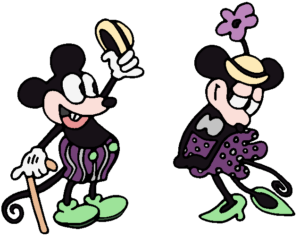
    Mickey and Minnie from title card color

    What is Public Domain Day?

    To put it simply, it is the day, typically January 1 in the US, where creative works lose their copyright and go into the public domain. When something goes into the public domain, you can reuse, remix, create with, or just simply enjoy the work without restriction.

    Copyright dates and lengths vary from country to country. In the US, if the work that was created before 1978, it is up to 95 years since publication (hence the work going out of copyright in 2026 is from 1930). Due to the Sonny Bono Act, works created after 1978 are life of the creator plus 70 years. So, if I published a book in 2015 (which I did) and died in 2042 (which I hope I won’t), the work will not be in the public domain until 2112 (70 years after my death).

    To give you another example, Jane Austen died in 1817. Since her work is in the public domain, her novel Pride and Prejudice was re-released with remixing, by Seth Grahame-Smith, into Pride and Prejudice and Zombies. By taking the original story and interjecting zombies, he created a whole new work without restriction from Austen or her estate. 


    Note: Pride and Prejudice and Zombies is a copyrighted work so you cannot remix, reuse, and repurpose the book without permission from Grahame-Smith.

    And another Austen example, I’m reading Pride and Prejudice over at my personal TikTok where I read a chapter a week. By re-using this content in a new and fresh way, not only am I taking advantage of Austen’s work in the public domain but I’m also spreading the word of Austen. (Win-win!)

    What’s the history of Public Domain Day?

    The use of the phrase “Public Domain Day” is recorded in 2004 by Wallace McLean (a Canadian public domain activist) with support by Lawrence Lessig (an American legal scholar). Websites and journals started writing articles on Public Domain Day as well as listing significant works going into the public domain. Over 20 years since that original idea, Public Domain Day is widely celebrated worldwide.

    How much are the works in the public domain?

    Free! You do not have to pay a single cent to use the work.

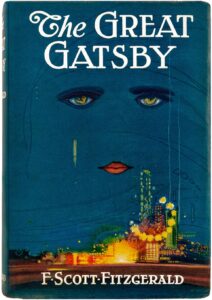
    The Great Gatsby Cover 1925 Retouched

    If I create something using a work in the public domain, can I sell it?

    Yes! If you search for Pride and Prejudice at your favorite online bookseller, you’ll see zillions of copies by different publishers. If you want to release your own version of Pride and Prejudice, lets say with commentary,  you absolutely can!

    What are examples of works in the public domain?

    Gosh! That’s a book in and of itself! Here are some works that have entered the public domain in the last few years:

    • The first instance of Mickey Mouse, in the cartoon Steamboat Willie, is in the public domain (though Disney is arguing about this)
    • F. Scott Fitzgerald’s The Beautiful and the Damned, The Great Gatsby, and This Side of Paradise
    • Music by Jelly Roll Morton, Bessie Smith, Al Jolson, and George Gershwin
    • Cecil B. DeMille’s film, “The Ten Commandments”
    • The first film adaptation of “Peter Pan”
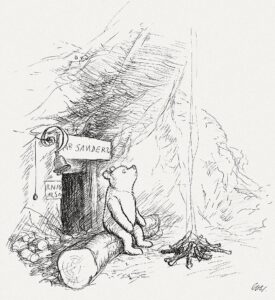
    • A.A. Mile’s Winnie-the-Pooh, Now We are Six, and House at Pooh Corner
    • Virginia Woolf’s To the Lighthouse, Orlando, A Room of One’s Own, and Mrs. Dalloway
    • The film, “The Jazz Singer”
    • “Animal Crackers,” the musical starring the Marx Brothers
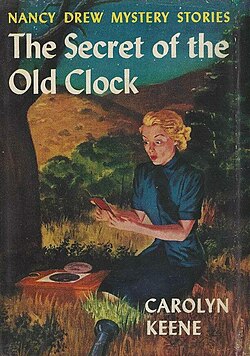
    • Carolyn Keene’s first four Nancy Drew books

    Remember, this is just the tip of the iceberg as there are literally millions of materials in the public domain.

    Pooh Shepard1928

    Where can I find a list of all the materials in the public domain?

    Hah! While I too had this question, the reality is that there are millions of items in the public domain and to manage a list is impossible. 

    But, I can help you with a bit! In 2019, Duke Law School started publishing a list of popular items going into the public domain. Here are those lists.

    • 2026 (1930 and earlier)
    • 2025 (1929 and earlier)
    • 2024 (1928 and earlier)
    • 2023 (1927 and earlier)
    • 2022 (1926 and earlier)
    • 2021 (1925 and earlier)
    • 2020 (1924 and earlier)
    • 2019 (1923 and earlier)

    Where can I find public domain materials?

    As a librarian, the first thing I will tell you is be very  careful on where you find materials claiming into being in the public domain. Here is a list of verified sites that have the millions of materials in the public domain.


    What are you going to create with works in the public domain?

    The Secret of the Old Clock (1930) cover art, 1953 printing (cropped)

    Further Reading