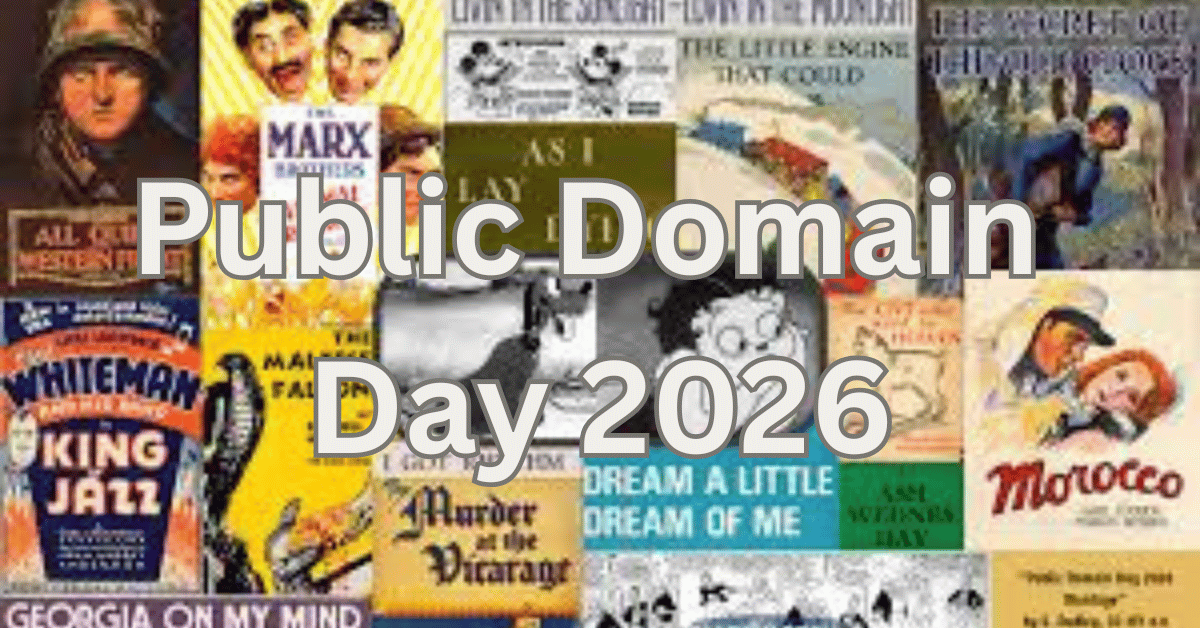
January 1 is Public Domain Day!
First, A Welcome
Today not only marks January 1, Public Domain Day, and the start of a new year but it is also the first article in The Blog of NGI!
The Blog of NGI will cover in-depth topics on a weekly basis, posting around 9 a.m. on Mondays. The articles will have a brief summary in the NGI newsletter (Have you subscribed yet?) as well as a line or two in NGI TV.
(The next issue drops on January 12!)
Topics covered will be things history of tech, rants and raves, analysis, and whatever else I can think of. I keep the newsletter pretty short but I wanted a place to really stretch my creativity and that’s where NGI TV and The Blog of NGI comes in!
Now on with the show!
What is Public Domain Day?
To put it simply, it is the day, typically January 1 in the US, where creative works lose their copyright and go into the public domain. When something goes into the public domain, you can reuse, remix, create with, or just simply enjoy the work without restriction.
Copyright dates and lengths vary from country to country. In the US, if the work that was created before 1978, it is up to 95 years since publication (hence the work going out of copyright in 2026 is from 1930). Due to the Sonny Bono Act, works created after 1978 are life of the creator plus 70 years. So, if I published a book in 2015 (which I did) and died in 2042 (which I hope I won’t), the work will not be in the public domain until 2112 (70 years after my death).
To give you another example, Jane Austen died in 1817. Since her work is in the public domain, her novel Pride and Prejudice was re-released with remixing, by Seth Grahame-Smith, into Pride and Prejudice and Zombies. By taking the original story and interjecting zombies, he created a whole new work without restriction from Austen or her estate.
Note: Pride and Prejudice and Zombies is a copyrighted work so you cannot remix, reuse, and repurpose the book without permission from Grahame-Smith.
And another Austen example, I’m reading Pride and Prejudice over at my personal TikTok where I read a chapter a week. By re-using this content in a new and fresh way, not only am I taking advantage of Austen’s work in the public domain but I’m also spreading the word of Austen. (Win-win!)
What’s the history of Public Domain Day?
The use of the phrase “Public Domain Day” is recorded in 2004 by Wallace McLean (a Canadian public domain activist) with support by Lawrence Lessig (an American legal scholar). Websites and journals started writing articles on Public Domain Day as well as listing significant works going into the public domain. Over 20 years since that original idea, Public Domain Day is widely celebrated worldwide.
How much are the works in the public domain?
Free! You do not have to pay a single cent to use the work.
If I create something using a work in the public domain, can I sell it?
Yes! If you search for Pride and Prejudice at your favorite online bookseller, you’ll see zillions of copies by different publishers. If you want to release your own version of Pride and Prejudice, lets say with commentary, you absolutely can!
What are examples of works in the public domain?
Gosh! That’s a book in and of itself! Here are some works that have entered the public domain in the last few years:
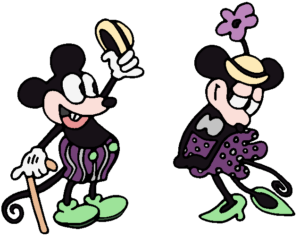
- The first instance of Mickey Mouse, in the cartoon Steamboat Willie, is in the public domain (though Disney is arguing about this)
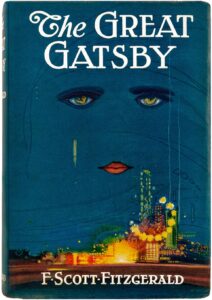
- F. Scott Fitzgerald’s The Beautiful and the Damned, The Great Gatsby, and This Side of Paradise
- Music by Jelly Roll Morton, Bessie Smith, Al Jolson, and George Gershwin
- Cecil B. DeMille’s film, “The Ten Commandments”
- The first film adaptation of “Peter Pan”
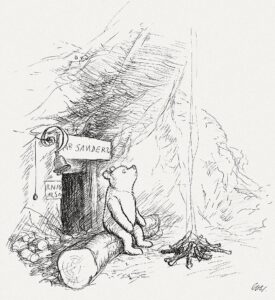
- A.A. Mile’s Winnie-the-Pooh, Now We are Six, and House at Pooh Corner
- Virginia Woolf’s To the Lighthouse, Orlando, A Room of One’s Own, and Mrs. Dalloway
- The film, “The Jazz Singer”
- “Animal Crackers,” the musical starring the Marx Brothers
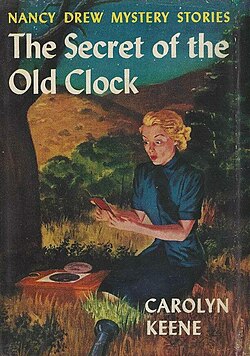
- Carolyn Keene’s first four Nancy Drew books
Remember, this is just the tip of the iceberg as there are literally millions of materials in the public domain.
Where can I find a list of all the materials in the public domain?
Hah! While I too had this question, the reality is that there are millions of items in the public domain and to manage a list is impossible.
But, I can help you with a bit! In 2019, Duke Law School started publishing a list of popular items going into the public domain. Here are those lists.
- 2026 (1930 and earlier)
- 2025 (1929 and earlier)
- 2024 (1928 and earlier)
- 2023 (1927 and earlier)
- 2022 (1926 and earlier)
- 2021 (1925 and earlier)
- 2020 (1924 and earlier)
- 2019 (1923 and earlier)
Where can I find public domain materials?
As a librarian, the first thing I will tell you is be very careful on where you find materials claiming into being in the public domain. Here is a list of verified sites that have the millions of materials in the public domain.
- Internet Archive (books, music, video, and publications)
- HathiTrust (books and publications)
- Project Gutenberg (books)
- Library of Congress (books and music)
What are you going to create with works in the public domain?